Vegetarian
Falafel wrap with tahini
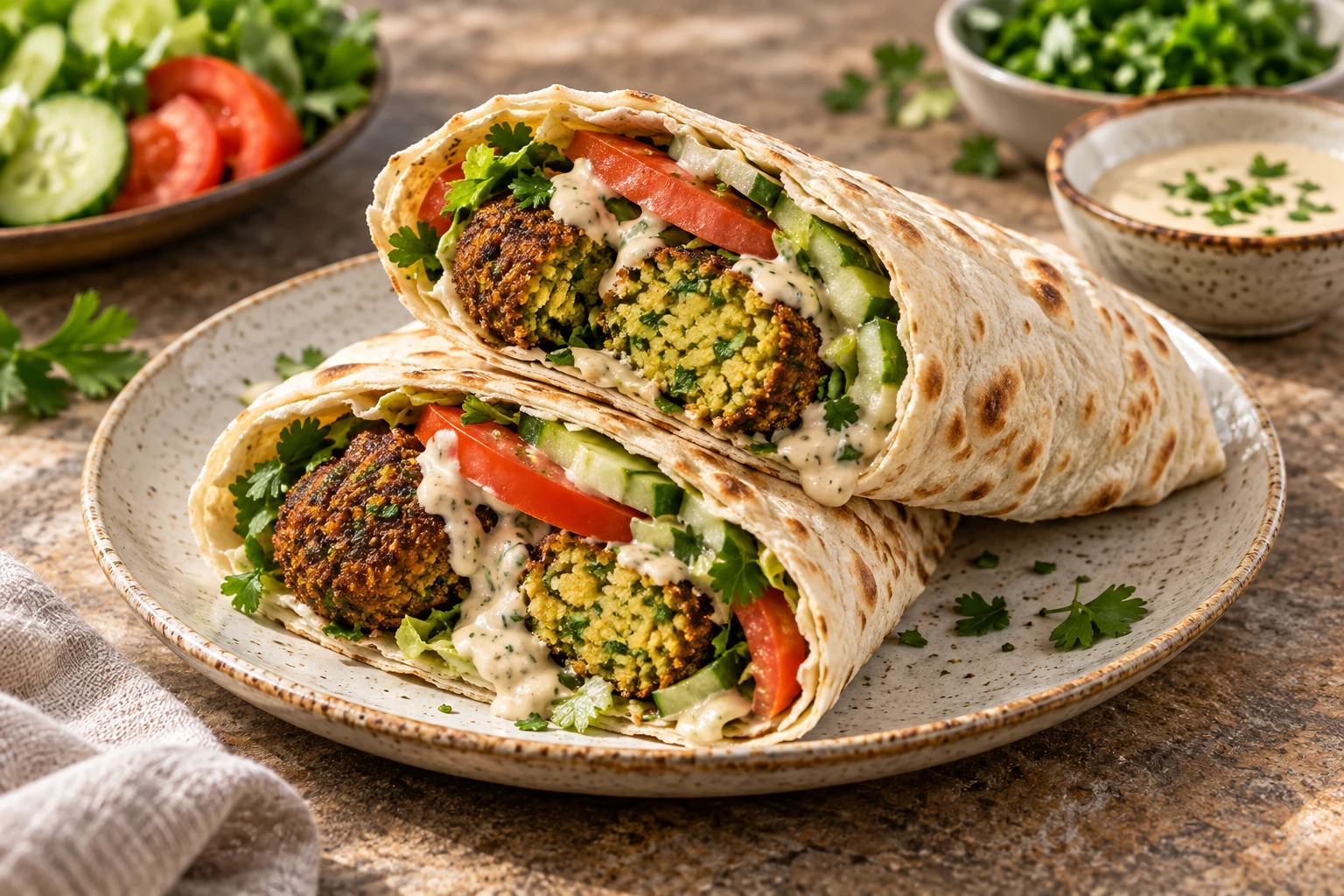
AI-generated serving image
This image was created with the help of artificial intelligence and serves as visual inspiration or a serving suggestion. The actual result may vary depending on the ingredients, quantities and preparation used.
Crisp falafel made from soaked chickpeas, fresh vegetables and lemon tahini in thin flatbread. Lebanese versions also use peeled fava beans; this version uses dried chickpeas alone.
Timing
- Preparation: about 30 minutes
- Soaking: 12–18 hours; chilling: 30 minutes
- Frying: about 20 minutes in batches
- Total time: about 13 hours 20 minutes to 19 hours 20 minutes
Estimated nutrition
per serving · Calculated for 4 servings.
- Energy
- ≈ 635 kcal
- Protein
- ≈ 25.3 g
- Carbohydrates
- ≈ 63.1 g
- Fat
- ≈ 26.7 g
The nutrition values are estimates based on the ingredients and quantities used. Actual values may vary depending on the product, portion size and preparation.
Calculation basis
Item weights and household measures are estimated. Unless specified: milk with 1.5% fat, cream with 30% fat and Gouda cheese. Optional ingredients, small amounts of seasoning and separately listed side dishes are excluded. For imprecise entries, the amounts below and comparable reference products are assumed. For alternatives, the first listed ingredient is used. Cooking losses have not been measured.
Includes 300 g dry chickpeas, 240 g bread and the full tahini sauce. Parsley is used as a comparison for coriander leaves. Assumes 32 g absorbed frying oil for four servings, excluding the remaining oil bath.
Quantity assumptions and ingredient mapping
- 20 g fresh coriander leaves · ≈ 20 g · Assumed quantity / reference product
- 1 l neutral frying oil; not all is absorbed · ≈ 32 g
- 90 g tahini · ≈ 90 g · Assumed quantity / reference product
- 4 thin Arabic flatbreads, about 240 g total · ≈ 240 g · Assumed quantity / reference product
Matvaretabellen: Mattilsynet · Santa Maria
Food data: Max Rubner-Institut, BLS 4.0 (2025), CC BY 4.0. Calculated and rounded for this recipe. BLS 4.0 · CC BY 4.0
Ingredients
- 300 g dried chickpeas
- 100 g onion
- 15 g garlic, divided
- 30 g flat-leaf parsley
- 20 g fresh coriander leaves
- 3 g ground coriander seeds
- 3 g baking powder
- 6 g salt, divided
- 1 l neutral frying oil; not all is absorbed
- 90 g tahini
- 30 ml lemon juice
- 80 ml cold water for the sauce
- 4 thin Arabic flatbreads, about 240 g total
- 200 g tomatoes
- 200 g cucumber
- 80 g lettuce
Instructions
- Rinse the chickpeas, cover generously with cold water and soak in the refrigerator for 12–18 hours. Drain thoroughly. Do not precook; canned chickpeas are unsuitable for this mixture.
- Roughly chop the onion and 12 g garlic. Process in batches with chickpeas, parsley, fresh and ground coriander and 5 g salt to fine, grainy crumbs. The mixture should hold when squeezed, without becoming a smooth purée. Cover and chill for 30 minutes.
- While the mixture chills, stir tahini with lemon juice, remaining finely grated garlic and 1 g salt. Gradually whisk in 80 ml water until creamy and pourable. Wash and thinly slice the vegetables.
- Fold in the baking powder just before frying. Shape about 20 small balls, pressing firmly and flattening slightly. Heat oil to 170–175 °C in a deep pan filled no more than halfway.
- Fry one test falafel for 5–6 minutes. Cut it open: the centre should be cooked and fluffy, without a wet or raw-tasting interior. Fry the remainder in small batches, allowing about 20 minutes altogether. Drain on kitchen paper.
- Briefly warm the flatbreads, spread with tahini sauce and add lettuce, cucumber, tomato and five falafel each. Roll firmly and serve straight away.
Tips
- If the test falafel breaks up, process the mixture a little finer and press more firmly. Avoid drying it out with large amounts of flour.
- Prepare sauce and vegetables during chilling; overlapping work is not counted twice in the total.