Rice dishes
Beef and vegetable gimbap
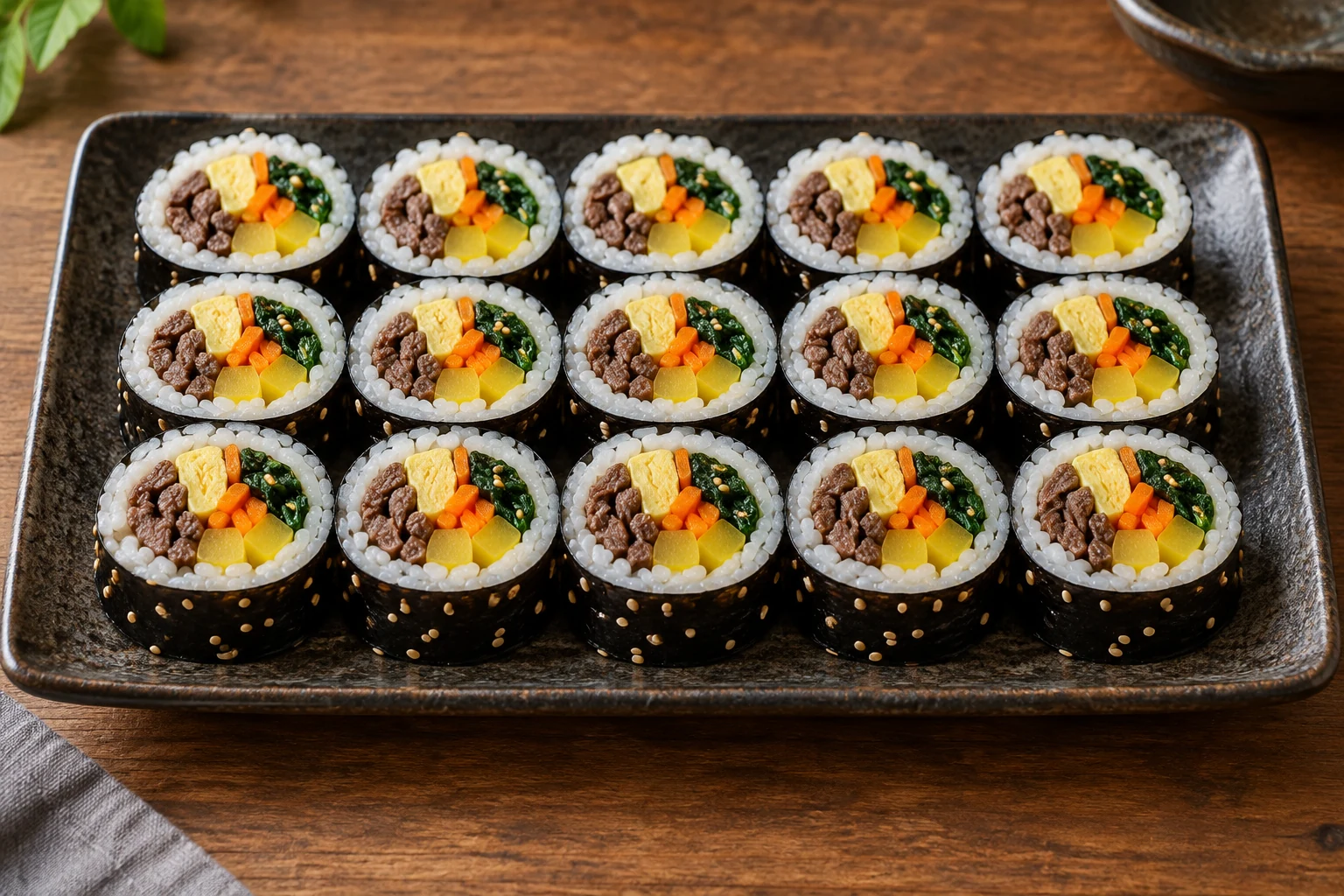
AI-generated serving image
This image was created with the help of artificial intelligence and serves as visual inspiration or a serving suggestion. The actual result may vary depending on the ingredients, quantities and preparation used.
Rice rolls filled with beef, egg, spinach, carrot and yellow pickled radish. Unlike sushi rice, this rice is seasoned with sesame oil rather than vinegar. Four large rolls make a meal for four.
Timing
- Preparation and rolling: about 35 minutes
- Cooking: about 25 minutes, with some tasks overlapping
- Total time: about 60 minutes
Estimated nutrition
per serving · Calculated for 4 servings.
- Energy
- ≈ 510 kcal
- Protein
- ≈ 25.3 g
- Carbohydrates
- ≈ 65.6 g
- Fat
- ≈ 14.7 g
The nutrition values are estimates based on the ingredients and quantities used. Actual values may vary depending on the product, portion size and preparation.
Calculation basis
Item weights and household measures are estimated. Unless specified: milk with 1.5% fat, cream with 30% fat and Gouda cheese. Optional ingredients, small amounts of seasoning and separately listed side dishes are excluded. For imprecise entries, the amounts below and comparable reference products are assumed. For alternatives, the first listed ingredient is used. Cooking losses have not been measured.
Rice is counted as 300 g dry weight. Four seaweed sheets are estimated at 10 g, eggs at 150 g without shells. Danmuji uses a comparison model of 85 g radish, 10 g sugar and 5 g vinegar.
Quantity assumptions and ingredient mapping
- 4 large nori or gim sheets · ≈ 10 g
- 200 g beef rump steak · ≈ 200 g · Assumed quantity / reference product
- 3 eggs · ≈ 150 g
- 100 g drained yellow pickled radish (danmuji) · ≈ 100 g · Assumed quantity / reference product
Matvaretabellen: Mattilsynet · Santa Maria
Food data: Max Rubner-Institut, BLS 4.0 (2025), CC BY 4.0. Calculated and rounded for this recipe. BLS 4.0 · CC BY 4.0
Ingredients
- 300 g dry Korean or Japanese short-grain rice
- 360 ml water for rice, adjusting to packet instructions if needed
- 4 large nori or gim sheets
- 200 g beef rump steak
- 3 eggs
- 200 g fresh spinach
- 150 g carrots
- 100 g drained yellow pickled radish (danmuji)
- 20 ml toasted sesame oil, divided
- 15 ml neutral oil, divided
- 15 ml soy sauce
- 5 g sugar
- 6 g garlic
- 4 g salt, divided
- 10 g toasted sesame seeds
Instructions
- Rinse rice and cook with the measured water according to the packet, roughly 15 minutes at a gentle simmer followed by 10 minutes resting covered. Spread in a shallow bowl and mix with 10 ml sesame oil and 1 g salt. Cool just until no longer steaming.
- While the rice cooks, slice the beef very thinly across the grain and mix with soy sauce, sugar and finely grated garlic. Cut carrot into fine matchsticks and radish into four long strips. Wash spinach.
- Blanch spinach in boiling water for 1 minute, cool under cold water and squeeze thoroughly. Season with 5 ml sesame oil and 1 g salt. Stir-fry carrot in 5 ml neutral oil for 3–4 minutes until just tender. Transfer each to a clean plate.
- Beat eggs with the remaining salt. Cook a thin omelette in 5 ml neutral oil over low to medium heat until fully set, turn and cut into strips. Stir-fry beef in the remaining neutral oil for 3–5 minutes until fully cooked.
- Place a gim sheet shiny-side down on a bamboo mat. Spread with one quarter of the rice, leaving 3 cm bare at the top. Arrange one quarter of each filling across the lower half. Roll firmly with the mat, keeping the mat outside the roll. Set seam-side down and repeat.
- Brush lightly with the remaining 5 ml sesame oil, sprinkle with sesame and cut into roughly 2 cm pieces using a clean damp sharp knife. Serve immediately.
Tips
- Danmuji is yellow pickled radish. Plain raw radish is not an equivalent ingredient.
- Avoid overfilling: serve excess filling alongside instead of splitting the wrapper.