Rice dishes
Nasi goreng with fried egg
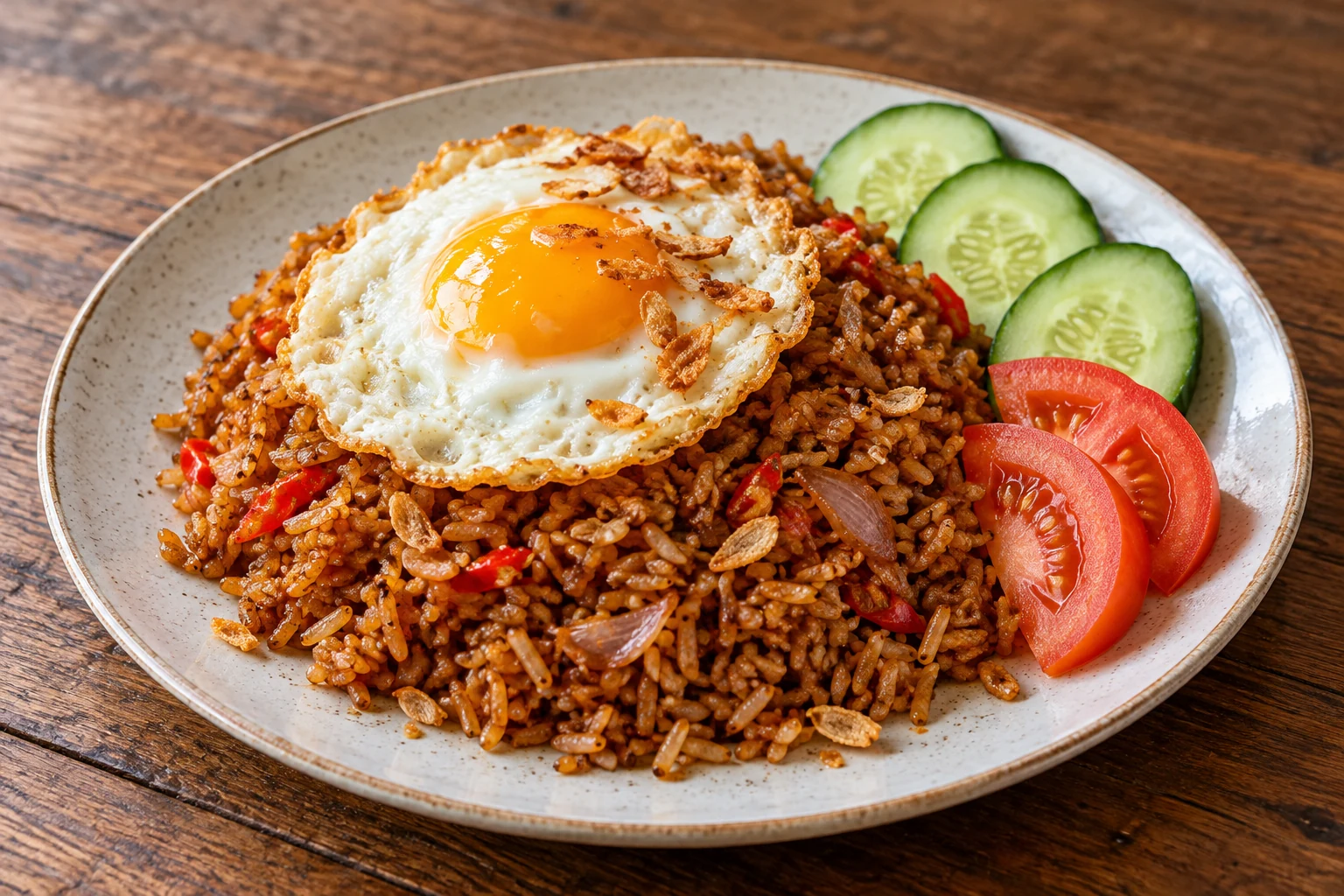
AI-generated serving image
This image was created with the help of artificial intelligence and serves as visual inspiration or a serving suggestion. The actual result may vary depending on the ingredients, quantities and preparation used.
Indonesian fried rice with kecap manis, shallots, chilli and a little shrimp paste. Rice takes centre stage, accompanied by egg and fresh cucumber. The method starts with dry rice and includes the necessary cooling time.
Timing
- Preparation: about 20 minutes, including about 15 minutes during cooling
- Rice cooking and resting: about 25 minutes
- Cooling: about 60 minutes; frying: about 20 minutes
- Total time starting with dry rice: about 1 hour 50 minutes
Estimated nutrition
per serving · Calculated for 4 servings.
- Energy
- ≈ 500 kcal
- Protein
- ≈ 15.2 g
- Carbohydrates
- ≈ 71.7 g
- Fat
- ≈ 15.4 g
The nutrition values are estimates based on the ingredients and quantities used. Actual values may vary depending on the product, portion size and preparation.
Calculation basis
Item weights and household measures are estimated. Unless specified: milk with 1.5% fat, cream with 30% fat and Gouda cheese. Optional ingredients, small amounts of seasoning and separately listed side dishes are excluded. For imprecise entries, the amounts below and comparable reference products are assumed. For alternatives, the first listed ingredient is used. Cooking losses have not been measured.
Includes 300 g dry rice and 200 g egg without shells. Kecap manis: 65% brown sugar and 35% soy sauce. The 5 g terasi uses fish sauce as a small comparison quantity, not an identical food. Fried onions are a comparison for fried shallots.
Fischsauce (Santa Maria Referenzprodukt)
Quantity assumptions and ingredient mapping
- 10 g red chilli · ≈ 10.0 g · Assumed quantity / reference product
- 5 g terasi, Indonesian shrimp paste · ≈ 5 g · Assumed quantity / reference product
- 50 g kecap manis · ≈ 50.0 g · Assumed quantity / reference product
- 4 eggs · ≈ 200 g
- 20 g crisp fried shallots · ≈ 20 g · Assumed quantity / reference product
Matvaretabellen: Mattilsynet · Santa Maria
Food data: Max Rubner-Institut, BLS 4.0 (2025), CC BY 4.0. Calculated and rounded for this recipe. BLS 4.0 · CC BY 4.0
Ingredients
- 300 g dry long-grain rice
- 450 ml water for rice, adjusting to packet instructions
- 100 g shallots
- 15 g garlic
- 10 g red chilli
- 5 g terasi, Indonesian shrimp paste
- 50 g kecap manis
- 15 ml soy sauce
- 35 ml neutral oil, divided
- 4 eggs
- 200 g cucumber
- 200 g tomatoes
- 20 g crisp fried shallots
- 1 g white pepper
Instructions
- Rinse rice and cook with the measured water following the packet, roughly 15 minutes simmering and 10 minutes resting covered. Immediately spread thinly in a clean shallow dish, let steam escape briefly and cool completely in the refrigerator promptly. Allow about 60 minutes; do not leave at room temperature for hours.
- During cooling, finely chop or pound shallots, garlic and chilli into a coarse paste. Wash and slice cucumber and tomatoes. Gently separate the cold rice grains with a fork before frying.
- Heat 10 ml oil in a pan and fry the four eggs until the whites, and yolks as needed, are set. Cook eggs fully for vulnerable people. Keep hot briefly.
- Preheat a wok or large pan well. Divide the remaining 25 ml oil, spice paste and terasi between two batches. Stir-fry each portion of paste and terasi for 2 minutes, then add half the rice. Stir-fry for another 3–4 minutes until hot with separated grains.
- Add half each of the kecap manis, soy sauce and pepper and fry for 1–2 more minutes. Repeat with the second batch. Serve immediately with one egg per portion, cucumber, tomato and fried shallots.
Tips
- Using about 750 g previously cooked, safely chilled rice reduces preparation to about 35–40 minutes. The main total explicitly includes cooking and cooling.
- Terasi contains crustaceans. Omitting it produces a milder variation, but the eggs mean the dish is still not vegan.