Oven
Salteñas – juicy filled dumplings
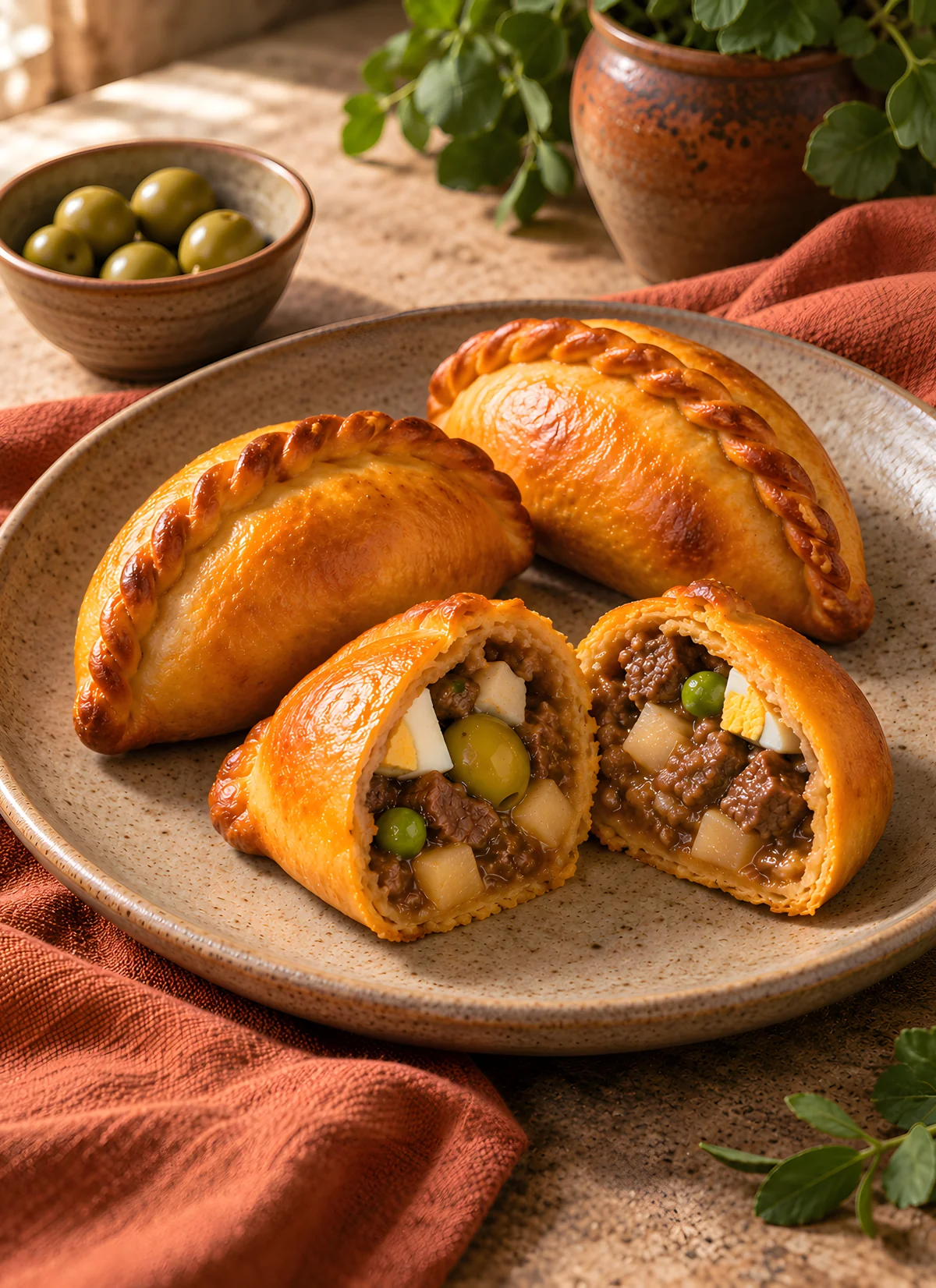
AI-generated serving image
This image was created with the help of artificial intelligence and serves as visual inspiration or a serving suggestion. The actual result may vary depending on the ingredients, quantities and preparation used.
Bolivian oven pockets with gelled filling that becomes liquid again when baked.
Timing
- Preparation: 75 min.
- Cooking/Baking: 45 mins.
- Rest/cooling: Cool filling for 6 hours + dough for 30 minutes
Estimated nutrition
per serving · Calculated for 6 servings.
- Energy
- ≈ 745 kcal
- Protein
- ≈ 35.3 g
- Carbohydrates
- ≈ 84.6 g
- Fat
- ≈ 28 g
The nutrition values are estimates based on the ingredients and quantities used. Actual values may vary depending on the product, portion size and preparation.
Calculation basis
Item weights and household measures are estimated. Unless specified: milk with 1.5% fat, cream with 30% fat and Gouda cheese. Optional ingredients, small amounts of seasoning and separately listed side dishes are excluded. For imprecise entries, the amounts below and comparable reference products are assumed. For alternatives, the first listed ingredient is used. Cooking losses have not been measured.
Calculated estimate using the reference foods below. Substitute products, item weights and consumed fractions are assumptions. Ordinary cooking oil and marinades are counted in full; frying oil, coatings, bones and whole roasts use the stated factors. The higher serving count is used for ranges. Actual product values and cooking losses have not been measured.
Paprikapulver (Matvaretabellen)
Ingredient amounts for the whole recipe; linked reference names retain the source language
- 600 g wheat flour type 405 · ≈ 600 g · Assumed quantity / reference product
Weizen Mehl, Type 405 (C214100) - 120g butter · ≈ 120 g · Assumed quantity / reference product
Butter mild gesäuert (Q611000) - 1 egg (M) · ≈ 50 g · Assumed item weight × count; total amount
Hühnerei roh (E111100) - 230 ml lukewarm water · ≈ 230 g · Assumed quantity / reference product
Trinkwasser (N110000) - 25g sugar · ≈ 25 g · Assumed quantity / reference product
Zucker weiß (Raffinadezucker/Weißzucker) (S111000) - 1 tsp achiote oil · ≈ 4.55 g · Assumed quantity / reference product
Rapsöl/Rüböl (Q180000) - 450 g beef finely diced · ≈ 450 g · Assumed quantity / reference product
Rind Muskelfleisch, roh (U201000) - 220 g onions · ≈ 220 g · Assumed quantity / reference product
Speisezwiebel roh (G480100) - 150 g cooked potatoes in cubes · ≈ 150 g · Assumed quantity / reference product
Kartoffel geschält, roh (K110100) - 100 g cooked peas · ≈ 100 g · Assumed quantity / reference product
Erbse grün, tiefgefroren, gekocht (G760232) - 450 ml strong beef broth · ≈ 450 g · Assumed quantity / reference product
Rindfleischbrühe Konserve (U985200) - 12 g ground gelatin · ≈ 12 g · Assumed quantity / reference product
Gelatine/Speisegelatine (R468000) - 50 ml cold water for swelling · ≈ 50 g · Assumed quantity / reference product
Trinkwasser (N110000) - 30 ml oil · ≈ 27.3 g · Assumed quantity / reference product
Rapsöl/Rüböl (Q180000) - 1 tsp paprika · ≈ 2.5 g · Assumed quantity / reference product
Paprikapulver (Matvaretabellen) (PAPRIKA) - 2 hard-boiled eggs · ≈ 100 g · Assumed item weight × count; total amount
Hühnerei gekocht (E111132) - 12 pitted olives · ≈ 48 g · Assumed item weight × count; total amount
Oliven grün, gesäuert, abgetropft (H510802)
Not included in the base calculation
- 8g salt · Salt or small seasoning amount; no salt/micronutrient calculation
- 1 tsp cumin · Salt or small seasoning amount; no salt/micronutrient calculation
- 2 tbsp Ají amarillo paste optional · Optional ingredient or inedible equipment
Matvaretabellen: Mattilsynet · Santa Maria
Food data: Max Rubner-Institut, BLS 4.0 (2025), CC BY 4.0. Calculated and rounded for this recipe. BLS 4.0 · CC BY 4.0
Ingredients
- 600 g wheat flour type 405
- 120g butter
- 1 egg (M)
- 230 ml lukewarm water
- 25g sugar
- 8g salt
- 1 tsp achiote oil
- 450 g beef finely diced
- 220 g onions
- 150 g cooked potatoes in cubes
- 100 g cooked peas
- 450 ml strong beef broth
- 12 g ground gelatin
- 50 ml cold water for swelling
- 30 ml oil
- 1 tsp cumin
- 1 tsp paprika
- 2 tbsp Ají amarillo paste optional
- 2 hard-boiled eggs
- 12 pitted olives
Instructions
- For the filling, sauté the onions in 30 ml oil for 5 minutes, add the meat and fry vigorously all over. Season with cumin, paprika and aji.
- Pour in the broth and cook the meat for 15-20 minutes over low heat; Add potatoes and peas. Let the gelatine soak in 50 ml of cold water for 5 minutes and dissolve in the hot, no longer boiling filling.
- Pour the filling into a flat mold, let it cool quickly and let it solidify in the refrigerator for at least 6 hours.
- Mix flour, salt and sugar, incorporate butter, add egg, achiote and 230 ml water; Knead for 8 minutes and let rest covered for 30 minutes.
- Divide the dough into twelve balls and roll each out into circles about 14 cm in size. Add a heaping spoonful of cold jellied filling, a piece of egg and an olive. Close the edges carefully and fold decoratively at the top.
- Bake on baking paper at 220 °C top/bottom heat for around 20-25 minutes until the pockets are deeply browned and hot inside. Allow to cool for a few minutes – the filling will be very hot.
Tips
- Only a really solid, cold filling can be sealed tightly. Bake the pockets upright with the seam at the top.
- Food safety: Gelatin binds the filling in this home version; Other methods are also common regionally. Hot liquid core: risk of scalding.
- Technology: Germany: Gelatin powder according to package instructions, for vegetarian versions a completely separate recipe would have to be developed; Ají paste from Latin shops.